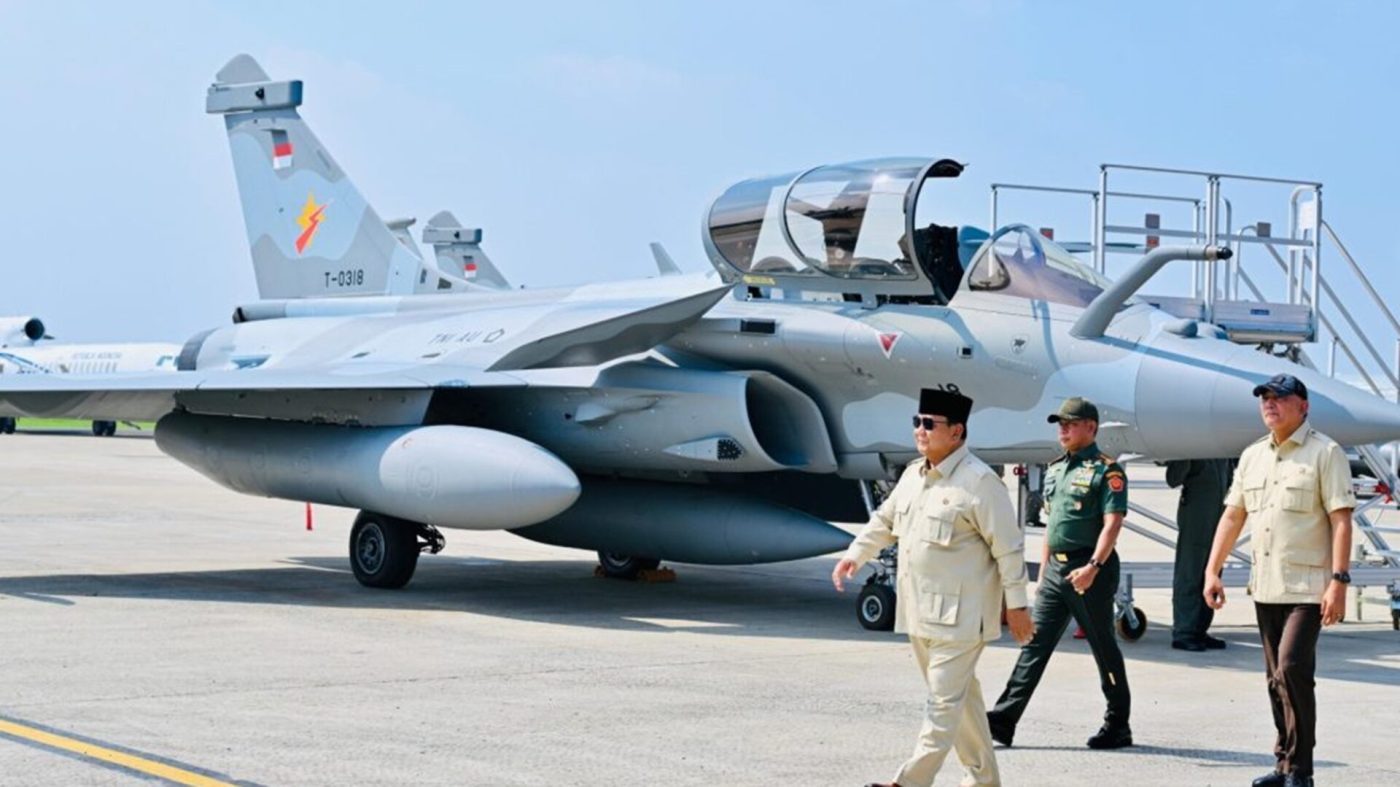
President Prabowo Subianto blessed a Rafale jet with flowered water at a Jakarta airbase. Behind the ceremony lay a sweeping defense overhaul that is quietly reshaping the military balance across Southeast Asia.
By The Index Today Staff · May 20, 2026 · Asia · 8 min read
The image was striking in its contrasts. On a tarmac at Halim Perdanakusuma Air Force Base in Jakarta, President Prabowo Subianto — a former special forces commander who spent decades navigating Indonesia’s military and political hierarchies — sprayed flowered water onto the nose cone of a Dassault Rafale fighter jet. The gesture, an Indonesian tradition of blessing and good fortune upon receiving something new, was intimate, almost tender. The object receiving the blessing was a twin-engine multirole combat aircraft capable of delivering Meteor beyond-visual-range missiles at speeds exceeding Mach 4.
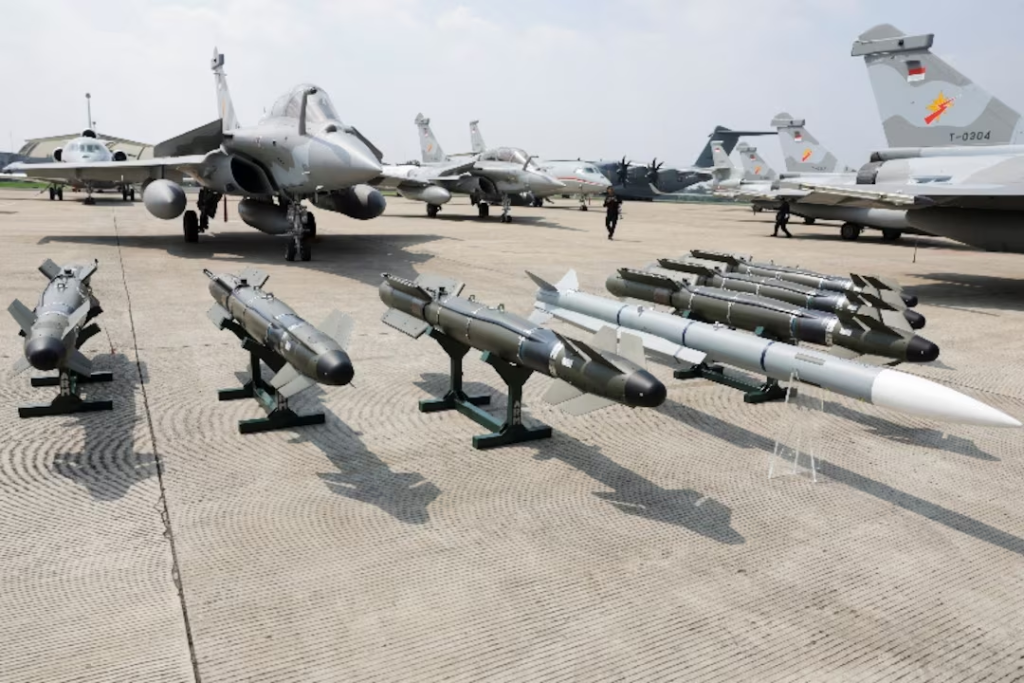
The ceremony on May 18 marked the formal induction of six Rafale fighters into Indonesian Air Force service, joining three that arrived in January at Roesmin Nurjadin Air Base in Pekanbaru, Sumatra. But the handover extended well beyond the jets themselves. Lined up alongside the Rafales were four Dassault Falcon 8X aircraft for VIP and command transport, an Airbus A400M military airlifter, a Thales GM403 ground-controlled interception radar, and initial deliveries of MBDA Meteor air-to-air missiles and Safran AASM Hammer precision-guided munitions. Taken together, the package represented one of the most significant single-day military deliveries in Indonesian history — and it was only the beginning.
The $8.1 Billion Deal
The aircraft are part of a 42-jet order that Jakarta signed with Dassault Aviation in February 2022, when Prabowo was serving as defense minister under President Joko Widodo. The deal, valued at approximately $8.1 billion, made Indonesia the largest French arms client in Southeast Asia and one of the biggest globally. It was structured in three tranches, with deliveries expected to continue through the end of the decade. A letter of intent signed during a French state visit in May 2025 signaled that follow-on orders are already under discussion.
The six aircraft delivered this week are expected to form the core of Skadron Udara 12 — the “Black Panther” squadron — giving the Indonesian Air Force a new frontline unit built entirely around French multirole fighters. But the significance extends beyond the airframes. The accompanying weapons ecosystem — Meteor missiles offering one of the most advanced beyond-visual-range capabilities on the export market, Hammer precision munitions enabling standoff strike, and the GM403 radar providing networked early warning — signals Indonesia’s transition toward a modern, integrated combat architecture.
This is not a country buying prestige hardware for parade-ground display. This is a country building a layered deterrence structure.
Prabowo’s Vision
Speaking to reporters after the ceremony, Prabowo framed the acquisitions in characteristically measured terms. “We must continue to improve our defense capabilities to serve as a deterrent,” he said. “We do not have any interests other than protecting our own territory. We observe that the global geopolitical landscape is fraught with uncertainty, and we recognize that defense is a primary prerequisite for stability.”
The language was deliberately non-confrontational — a reflection of Indonesia’s longstanding foreign policy doctrine of non-alignment and strategic autonomy. Jakarta does not belong to any military alliance. It maintains diplomatic relationships with Washington, Beijing, Moscow, and everyone in between. Its membership in BRICS, announced last year, sits alongside deep economic ties with the United States, a growing defense relationship with France, and a pending order for South Korean KF-21 Boramae fighter jets that will further diversify its air combat fleet.
But non-alignment is not the same as passivity, and Prabowo — who came to power in 2024 on a platform that emphasized national strength alongside his predecessor’s development agenda — has moved aggressively to modernize Indonesia’s aging military infrastructure. Defense spending for 2026 has been set at roughly 337 trillion rupiah, approximately $19 billion — a figure that represents a sharp increase over previous years and reflects the urgency with which Jakarta views the current security environment.
The Strategic Context
Indonesia’s military modernization does not occur in a vacuum. The Indo-Pacific is experiencing its most significant arms buildup since the Cold War. China’s naval expansion continues at a pace that dwarfs every other country in the region. Beijing’s assertiveness in the South China Sea — where it has deployed coast guard vessels, maritime militia, and increasingly sophisticated surveillance systems to enforce disputed claims — directly affects Indonesian interests. Jakarta’s Natuna Islands, which sit at the southern edge of China’s nine-dash line, have been the site of repeated maritime confrontations.
Meanwhile, the broader regional landscape is shifting rapidly. Japan, under Prime Minister Sanae Takaichi, is pursuing constitutional revision to strengthen its military posture. Australia’s AUKUS submarine program is advancing. The Philippines has deepened its security partnership with the United States. India, under Narendra Modi, has expanded defense cooperation with virtually every country in the region. And the war in Iran has underscored how quickly geopolitical instability can ripple across trade routes that are vital to Southeast Asian economies.
For Indonesia — an archipelago of over 17,000 islands straddling some of the world’s most strategically important sea lanes — the calculus is straightforward. It cannot rely on any single power for its security. It cannot afford to be defenseless if the regional order deteriorates. And it cannot modernize on the cheap: the Indonesian Air Force currently operates one of the most complicated aircraft inventories in Southeast Asia, with aging American F-16s, Russian Sukhoi Su-27s and Su-30s, and now French Rafales all sharing the same operational space.
The Rafale acquisition, in this context, is not simply a procurement decision. It is a strategic bet on diversification — a deliberate effort to reduce dependence on any single supplier while acquiring capabilities that are interoperable with multiple potential partners.
The French Connection
The depth of France’s emerging role in Indonesian defense is worth noting. Dassault Aviation, Airbus, Thales, MBDA, and Safran now occupy central positions in Jakarta’s future airpower architecture. The relationship goes beyond transactional arms sales: it includes technology transfer provisions, maintenance and training infrastructure, and the kind of long-term industrial partnership that creates structural ties between the two countries’ defense establishments.
For Paris, Indonesia represents both a commercial prize and a strategic foothold in a region where French influence has historically been limited. Emmanuel Macron’s meeting with Prabowo in Paris last month focused explicitly on expanding strategic cooperation, and the signals from both sides suggest that the defense relationship will continue to deepen. The Falcon 8X deliveries consolidate Dassault as the principal supplier of Indonesia’s government and command transport fleet. The A400M expands strategic airlift capability. And the radar and missile systems create dependencies that will bind the two countries’ military establishments for decades.
What Comes Next
The Rafale is just one piece of a much larger puzzle. Indonesia is also acquiring KF-21 Boramae fighters from South Korea — a program in which Jakarta was originally a development partner before scaling back its financial commitment. Reports have also indicated interest in Chinese J-10C fighters, which would add yet another platform to an already eclectic fleet. The logic, from Jakarta’s perspective, is that diversity of supply equals resilience: no single country can cut off Indonesia’s access to spare parts, munitions, or technical support.
Prabowo has indicated he expects to acquire four more A400M airlifters, which would give Indonesia a genuine strategic airlift capability — the ability to project force and deliver humanitarian aid across its vast territory and beyond. The broader modernization plan also encompasses naval assets, cyber capabilities, and the kind of integrated command-and-control systems that modern warfare demands.
Whether Indonesia can afford the full scope of its ambitions remains an open question. Defense spending, while rising, competes with the infrastructure, education, and social welfare programs that are essential to a nation of 280 million people. The tension between guns and development is not new for Jakarta, and Prabowo’s ability to sustain public support for large-scale military procurement will depend on whether the broader economy continues to grow.
But for now, the direction is clear. Indonesia is arming itself — carefully, deliberately, and with a sophistication that reflects both the complexity of the threats it faces and the strategic flexibility it intends to preserve. The flowered water on the Rafale’s nose cone was a blessing. The Meteor missiles on its wings were a statement.