The chipmaker that powers the AI revolution is expected to post $79 billion in revenue — an 80 percent year-over-year surge. The stock is near all-time highs. Thirteen consecutive beats are on the line. And the question hanging over the entire technology sector is whether the insatiable demand for AI compute is still accelerating, or whether the first cracks are starting to show.
By The Index Today Staff · May 20, 2026 · Earnings · 10 min read
Every major earnings season has a centerpiece. This one belongs to Nvidia.
The company that has become, by virtually any measure, the most important hardware maker in the artificial intelligence economy will report its fiscal first-quarter 2027 results after market close on Wednesday, May 21. The stakes are enormous — not just for Nvidia, but for the entire constellation of companies, investors, and capital allocation decisions that orbit its results. When Nvidia reports, it is not merely disclosing its own financial performance. It is providing the single most reliable real-time signal about the health and trajectory of global AI infrastructure spending.
Analysts expect the company to post revenue of approximately $78.75 to $79.2 billion — an increase of roughly 80 percent year-over-year from the $44.06 billion it reported in Q1 last year. Earnings per share are projected at $1.76 to $1.78, up approximately 120 percent from a year ago. The data center business, which has become the overwhelming engine of Nvidia’s growth, is expected to contribute around $72.85 billion — of which $60.53 billion is forecast from compute and $12.45 billion from networking. Gaming is expected at $3.64 billion.
These numbers would, in any other context, be astonishing. For Nvidia in 2026, they represent the baseline.
The company has beaten Wall Street estimates for thirteen consecutive quarters. Its fiscal fourth-quarter revenue of $68.1 billion, reported in February, was up 73 percent year-over-year and 20 percent sequentially. Full fiscal year 2026 revenue hit a record $215.9 billion — up 65 percent from the previous year. Data center revenue in Q4 alone was $62.3 billion, with networking revenue surging 263 percent year-over-year as the NVLink compute fabric for Blackwell-based systems ramped at extraordinary speed.
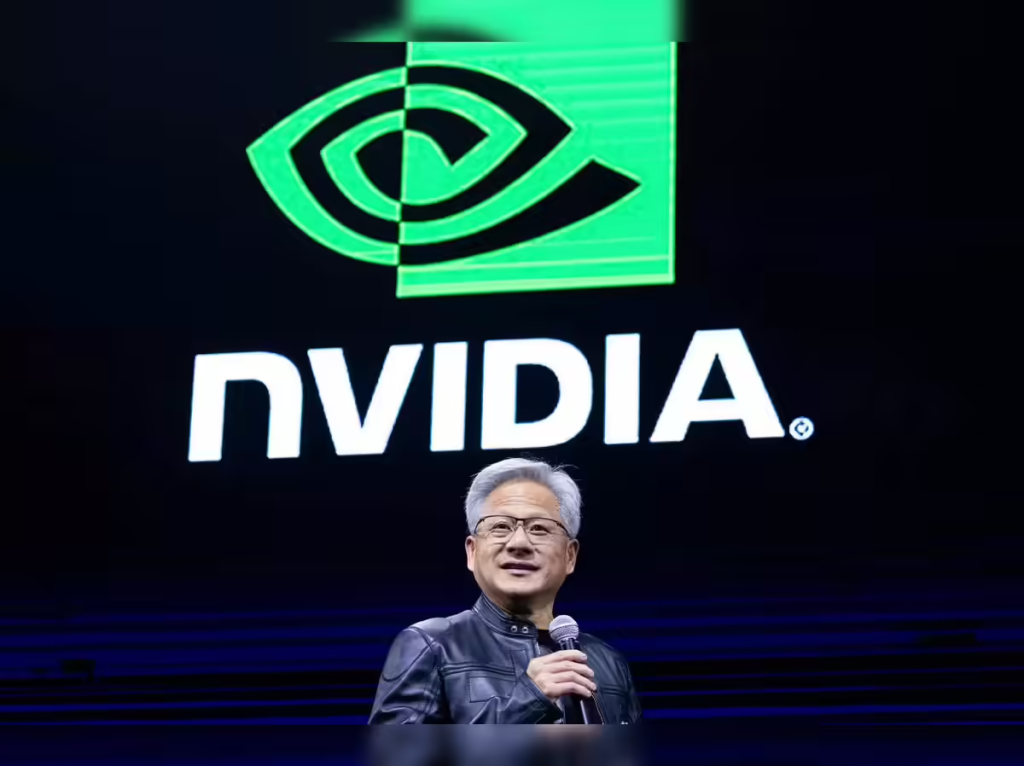
CEO Jensen Huang, who accompanied President Trump on his trip to Beijing last week, set the tone at the February earnings call with language that left little room for ambiguity: “Computing demand is growing exponentially — the agentic AI inflection point has arrived.”
The guidance for Q1 was $78 billion, plus or minus two percent. The fact that consensus estimates have clustered slightly above the top of that range suggests analysts expect yet another beat. But the more important signals will come not from the backward-looking revenue figure but from the forward-looking commentary — on demand sustainability, on the competitive landscape, on China, and on whether the capital expenditure commitments from Nvidia’s largest customers show any signs of fatigue.
What Investors Are Actually Watching
The headline revenue figure will get the initial market reaction. But four deeper questions will determine how investors process the results over the following days and weeks.
The first is data center growth trajectory. In Q4, data center revenue grew 75 percent year-over-year. That pace is expected to have accelerated slightly in Q1, with some analysts projecting an 86 percent year-over-year growth rate in Q2. Any signal that the trajectory is flattening — even if growth remains above 50 percent — would unsettle a market that has priced in sustained hypergrowth.
The second is the Blackwell architecture ramp. Nvidia’s next-generation Blackwell GPUs represent the company’s most important product cycle since the original AI training boom driven by the A100 and H100. Huang described Blackwell with the Grace architecture as “the king of inference today — delivering an order-of-magnitude lower cost per token.” The Q1 results will provide the clearest picture yet of how quickly Blackwell is scaling across customer categories and whether supply constraints are being resolved.
The third is the China question. Nvidia’s guidance explicitly stated that it was “not assuming any Data Center compute revenue from China in its outlook.” This reflects the ongoing U.S. export restrictions that have blocked Nvidia’s most advanced chips from the Chinese market. But Huang’s presence alongside Trump in Beijing has raised speculation about whether some form of access might be restored. Nvidia reportedly received clearance for its H200 chips to be sold to select Chinese companies during the summit. Any commentary from Huang on what came of that trip — and what it means for the revenue China can or cannot contribute — will be closely scrutinized.
The fourth is the sustainability of AI capital expenditure. Microsoft, Google, Amazon, and Meta are collectively spending an estimated $725 billion on data center capex in 2026 — a 77 percent increase over last year. Meta recently raised its 2026 capex guidance further, citing higher pricing for data center components. The hyperscalers remain Nvidia’s largest customer category, accounting for just under 50 percent of data center revenue. Any sign that these companies are moderating their spending plans — or any CEO commentary suggesting that AI returns are not yet justifying the investment — would ripple through Nvidia’s valuation.
The Valuation Question
Nvidia shares were trading around $222-223 heading into earnings week, up 18 percent year-to-date and near all-time highs. The stock trades at a forward price-to-earnings ratio that, while elevated in absolute terms, has historically been at the lower end of its range at the start of the year — only to rally through the summer following strong Q1 results.
The pattern is well established. Nvidia beats. The stock climbs. The cycle repeats. But thirteen consecutive beats have also created expectations that are, by definition, difficult to exceed. The market is not merely pricing in a strong quarter. It is pricing in continued upward revisions to guidance, continued acceleration in data center revenue, and continued confirmation that the AI capital expenditure cycle has years to run.
If Nvidia delivers again — and delivers commentary that reinforces the bull thesis — the stock has significant upside potential. Some analysts project that a return to 40 times forward earnings by year-end would represent meaningful appreciation from current levels. If the company merely meets expectations without raising guidance or providing upside commentary, the reaction could be muted or even negative, as the bar for a “good enough” report is extraordinarily high.
The Bigger Picture
Nvidia’s earnings are not, in the end, a story about one company. They are a proxy for the most consequential capital allocation shift of the decade. The world’s largest technology companies are building a physical infrastructure layer for artificial intelligence at a pace and scale that has no historical precedent. The data centers being constructed will consume unprecedented quantities of electricity, copper, water, and real estate. They will reshape energy grids, commodity markets, and urban planning. And the chips at the center of these facilities — the GPUs that train and run the models — are overwhelmingly supplied by a single company.
That concentration creates both extraordinary opportunity and extraordinary risk. If AI demand continues to grow exponentially, Nvidia’s position is nearly unassailable. If the demand curve bends — if customers decide they have built enough, or if open-source models reduce the compute requirements for useful AI, or if competitors like AMD and custom silicon from Google and Amazon erode market share — the repricing would be severe.
Wednesday’s report will not resolve these questions. But it will provide the freshest data point on the most important technology trend of the decade. And in a market that hangs on every word Jensen Huang says, the silence between the close of trading and the earnings call will feel very, very long.