Saudi Arabia’s state energy giant reported a 26 percent profit surge even as the Strait it traditionally depends on remained closed. The secret: a 7-million-barrel-per-day pipeline that most analysts had considered a strategic insurance policy. It just became the most valuable piece of infrastructure on earth.
By The Index Today Staff · May 20, 2026 · Earnings · 9 min read
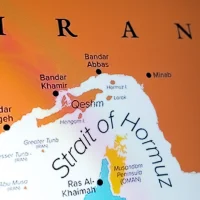
When the Strait of Hormuz closed on March 4, most energy analysts immediately began modeling worst-case scenarios for Saudi Aramco. The world’s largest oil company exports the vast majority of its crude from terminals on the Persian Gulf coast — Ras Tanura, Juaymah, the King Fahd Industrial Port at Jubail. All of them sit on the wrong side of the blockade. With Iranian forces threatening to “set ships ablaze” and tanker traffic collapsing to near zero, the assumption was that Aramco’s first-quarter results would show the strain of a supply route catastrophe.
The assumption was wrong.
On May 10, Aramco reported adjusted net income of $33.6 billion for the first quarter of 2026 — a 26 percent increase over the $26.6 billion earned in the same period last year and a 34 percent surge from the $25.1 billion in the previous quarter. The figure beat analyst consensus estimates of $30.95 to $31.2 billion. Total revenue climbed nearly 7 percent year-over-year to $115.49 billion, driven by higher crude prices and a volume mix that defied the maritime disruption.
The company declared a base dividend of $21.9 billion for the quarter — up 3.5 percent year-on-year and payable in the second quarter — maintaining the payout trajectory that the Saudi state depends on to fund its domestic spending programs and cover budget gaps. The government directly owns approximately 81.5 percent of Aramco, with the Public Investment Fund holding a further 16 percent. Aramco’s dividends are, for all practical purposes, the Saudi treasury’s primary funding mechanism.
“Aramco’s first-quarter performance reflects strong resilience and operational flexibility in a complex geopolitical environment,” CEO Amin Nasser said. The language was characteristically understated for a quarter that was anything but.
The Pipeline That Changed Everything
The single most consequential line in Aramco’s earnings report was not a revenue figure or a margin number. It was a capacity metric: the East-West Pipeline reached its maximum throughput of 7.0 million barrels per day.
The Petroline — formally the East-West Crude Oil Pipeline — runs approximately 1,200 kilometers from Aramco’s eastern oil fields across the Saudi desert to the Red Sea port of Yanbu. Built in the 1980s during the Iran-Iraq War as a strategic hedge against precisely the kind of Hormuz disruption that has now materialized, the pipeline had operated well below capacity for decades. It was infrastructure for a scenario that many assumed would never actually occur.
It has now occurred. And the pipeline has proven to be, without exaggeration, the most strategically valuable piece of energy infrastructure on earth. By redirecting crude exports from the Gulf coast to Yanbu — bypassing the Strait entirely — Aramco maintained substantial export volumes even as its competitors in Kuwait, Iraq, and the UAE saw their shipments stranded.
“Our East-West Pipeline has proven itself to be a critical supply artery, helping to mitigate the impact of a global energy shock and providing relief to customers affected by shipping constraints in the Strait of Hormuz,” Nasser said.
The pipeline does not eliminate the impact of the Hormuz closure. Aramco produced 11.1 million barrels per day in Q4 2025; the 7 million barrel per day pipeline capacity leaves a gap of over 4 million barrels per day that cannot be exported by the overland route. Refined products, LPG, and natural gas liquids from eastern processing facilities face their own constraints. And several Aramco facilities — including the Satorp refinery at Jubail, a 465,000 barrel-per-day joint venture with TotalEnergies, and the Samref refinery at Yanbu — were hit by Iranian drone and missile strikes during the quarter, disrupting refined product exports and causing one death and seven injuries.
But the core crude export capability survived. And in an oil market where every available barrel commands a premium, the ability to deliver when others cannot is worth far more than the commodity price alone suggests.
The Numbers Behind the Numbers
The financial details reveal both the windfall and the costs. Aramco’s average crude oil realized price rose to $76.90 per barrel in Q1, up from $76.30 a year ago and $64.10 in the prior quarter. The relatively modest increase in realized price — compared with the far larger jump in benchmark Brent — reflects the lagged nature of term contract pricing and the mix effects of higher pipeline shipments versus disrupted seaborne exports.
Capital expenditure of $12.1 billion in the quarter supported the company’s long-term growth objectives, including infrastructure investment that will be critical if the Hormuz situation persists. Free cash flow slipped to $18.6 billion from $19.2 billion a year ago, impacted by a $15.8 billion rise in working capital — a figure that reflects the logistical costs of rerouting exports and maintaining storage networks under wartime conditions.
Gearing — Aramco’s measure of leverage — rose modestly to 4.8 percent from 3.8 percent at year-end, a level that remains conservative by any industry standard and provides substantial financial flexibility for future investment.
What Nasser Warned About
If the quarter’s results were a testament to operational resilience, the CEO’s forward-looking commentary was a sobering reminder of the crisis’s broader dimensions. “If the Strait of Hormuz opens today, it will still take months for the market to rebalance,” Nasser warned investors. “And if its opening is delayed by a few more weeks, then normalization will last into 2027.”
The statement was notable for its candor. Aramco is one of the few companies in the world with the infrastructure, the production base, and the financial strength to weather the Hormuz disruption without existential risk. If Nasser is telling investors that normalization will take months to years, the implication for the rest of the industry — and for every economy that depends on Gulf energy — is deeply concerning.
Aramco’s Q1 results are not the story of a company triumphing over adversity. They are the story of a company that invested in contingency infrastructure decades ago and is now reaping the reward at a moment of extraordinary global vulnerability. The $33.6 billion profit is a number that reflects both the company’s foresight and the world’s fragility. The East-West Pipeline is operating at maximum capacity not because Aramco planned for this quarter, but because Saudi Arabia planned for this century.