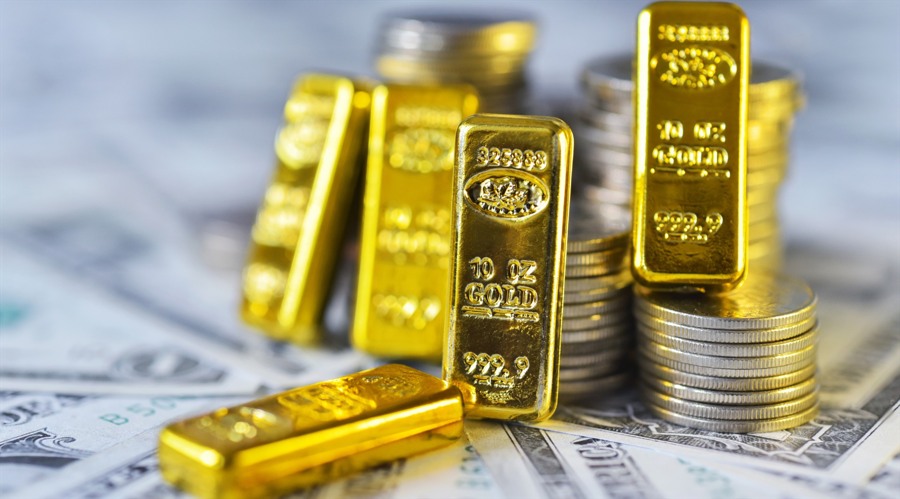
Central banks are buying at record pace. ETF inflows have doubled. Prices have roughly tripled in two years. The question is no longer why gold is rising — it’s what the rally is telling us about the world that’s coming.
By The Index Today Staff · May 20, 2026 · Commodities · 9 min read
On a Monday morning in January, spot gold traded at $4,689.15 per ounce — an all-time high that would have seemed hallucinatory just three years earlier, when the metal hovered near $2,000. By the end of the first quarter, the LBMA gold price had set a record quarterly average of $4,873 per ounce, with an intra-quarter peak above $5,400. Goldman Sachs raised its year-end 2026 forecast to $5,400 an ounce. Bank of America projected $5,000. So did Societe Generale and HSBC. For the first time in a generation, the most powerful institutions in global finance were converging around a single extraordinary consensus: gold was heading somewhere it had never been, and the forces driving it there showed no sign of exhaustion.
The numbers, taken in isolation, are remarkable. Gold gained more than 64 percent in 2025 — its strongest annual performance since 1971 — and posted 53 new record highs in a single calendar year. It has roughly tripled since early 2024. Silver has followed, surging 147 percent in 2025 and hitting a record $86.22 per ounce. Global gold ETF inflows reached $89 billion in 2025, the largest on record, and holdings of major physically backed ETFs reached levels not seen in years. In the first quarter of 2026 alone, central banks purchased between 244 and 337 tonnes — the strongest first quarter ever recorded.
But the numbers, remarkable as they are, are not the story. The story is what they represent: a structural realignment in how the world’s most sophisticated investors, central banks, and sovereign institutions think about risk, trust, and the architecture of the global financial system.
The Central Bank Bid
If there is a single factor that separates this gold rally from every previous one, it is the role of central banks. For four consecutive years — 2022, 2023, 2024, and 2025 — global central bank gold purchases have exceeded 850 tonnes annually, roughly double the long-term average from 2010 to 2021. The World Gold Council projects purchases of 700 to 900 tonnes in 2026, broadly consistent with recent levels and well above historical norms.
China’s central bank extended its gold-buying streak to 14 consecutive months through December 2025, bringing its holdings to 74.15 million fine troy ounces. But China is not alone. India, Turkey, Poland, Singapore, and a constellation of emerging market central banks have been steadily increasing their gold reserves, in many cases at record prices — behavior that defies conventional portfolio logic.
Why are central banks buying gold at the highest prices in history? The answer lies at the intersection of geopolitics, monetary policy, and institutional trust. The freezing of Russian central bank assets following the 2022 invasion of Ukraine demonstrated that dollar-denominated reserves — once considered the safest assets in the world — could be weaponized. For central banks in countries that do not fully align with Western foreign policy, the lesson was visceral: dollar reserves carry political risk. Gold carries none. It has no counterparty. It cannot be frozen, sanctioned, or seized. It sits in a vault in your own country and answers to no one’s foreign policy.
This is not a speculative thesis. It is an observable reallocation of sovereign capital on a scale that is reshaping the structural demand floor for gold. In November 2025, central bank purchases represented approximately 15 percent of total monthly global mine output — a rate of physical absorption that creates scarcity dynamics independent of speculative positioning.
The Iran War Premium
The outbreak of the Iran war in late February 2026 added a geopolitical risk premium to a rally that was already historically powerful. The closure of the Strait of Hormuz, the largest oil supply disruption ever recorded, sent commodity prices surging and inflation expectations rising. In that environment, gold’s role as the ultimate safe-haven asset was reinforced with an urgency that institutional investors had not felt since the early stages of the pandemic — or, for older traders, since the 1970s.
But the Iran premium is, in some sense, incidental. Gold was already posting record after record before the first shot was fired. The war accelerated an existing dynamic; it did not create one. The rally’s foundations — central bank buying, ETF inflows, monetary policy expectations, and the structural desire to diversify away from dollar-denominated reserves — were in place well before the first Iranian missile was launched.
What the war did accomplish was to validate the thesis. Every argument for gold as a hedge against geopolitical instability, supply chain disruption, and inflationary pressure was confirmed in real time over the course of March and April 2026. The traders and institutions that had positioned for exactly this kind of shock were rewarded. Those who hadn’t were scrambling to catch up.
The Monetary Policy Dimension
The Federal Reserve sits at the center of gold’s monetary equation. Gold has historically performed best during periods of falling or low real interest rates — environments in which the opportunity cost of holding a non-yielding asset diminishes. Expectations of rate cuts in the United States, which had been building throughout late 2025, provided a tailwind. But the Iran war complicated the picture: the commodity shock pushed headline inflation higher, making it harder for the Fed to cut without appearing to sacrifice its inflation mandate.
The result has been a kind of monetary paralysis that, paradoxically, benefits gold. If the Fed cuts rates, real yields fall and gold becomes more attractive. If the Fed holds or raises rates to fight inflation, it risks pushing the economy toward recession — an outcome that would drive safe-haven demand. The metal benefits in both scenarios, which is one reason the rally has proved so resilient to the kind of corrections that would normally follow a move of this magnitude.
UBS has noted that if real interest rates turn negative — a scenario that is no longer implausible given the trajectory of inflation — prices could be driven substantially higher still. The traditional 60/40 portfolio framework, which allocated capital between equities and bonds, is being quietly revised across the institutional investment world. Gold is no longer a peripheral allocation. It is a structural component.
The Supply Problem
On the supply side, the picture reinforces the bullish case. Global gold mine production has been essentially flat for several years, constrained by declining ore grades, rising extraction costs, and the long lead times required to bring new projects online. Recycling provides some additional supply, but not enough to offset the acceleration in demand. The physical gold market is tight, and getting tighter.
Asian physical demand — particularly from China, where bar and coin purchases have reached record quarterly volumes — remains the dominant growth engine. Eastern ETF inflows are more than compensating for outflows in Western markets, maintaining net positive demand globally despite geographic rotation. The structural deficit between new supply and total demand is widening.
What Gold Is Telling Us
Every major gold rally is, at its core, a signal — a market-scale expression of anxiety about the system within which all other assets are priced. The 1970s rally reflected the collapse of the Bretton Woods system and the dawn of free-floating currencies. The 2008-2011 rally reflected the global financial crisis and the unprecedented expansion of central bank balance sheets. The 2020 rally reflected the pandemic.
This rally reflects something broader and perhaps more durable: a loss of confidence in the stability of the international order itself. The weaponization of financial infrastructure, the fragmentation of global trade, the return of great-power conflict, the fiscal trajectories of major economies, and the erosion of institutional trust are not temporary conditions. They are structural features of the world that is emerging. Gold is not rising because the market is panicking. It is rising because the market is adapting to a world in which the old certainties — the safety of sovereign debt, the neutrality of the dollar system, the assumption that major wars are things that happen in history books — no longer hold.
The traders and institutions buying gold at $5,000 an ounce are not making a bet on a commodity. They are making a bet on a thesis about the future of the global system. And the fact that the world’s most conservative financial institutions — central banks, whose entire purpose is the preservation of stability — are making the same bet at the same time tells you everything you need to know about how seriously that thesis is being taken.
Whether gold reaches $6,000 or corrects back toward $4,000 in the near term is a question for traders. The larger question — what it means when a 5,000-year-old asset becomes the most dominant trade of a new century — is a question for everyone.