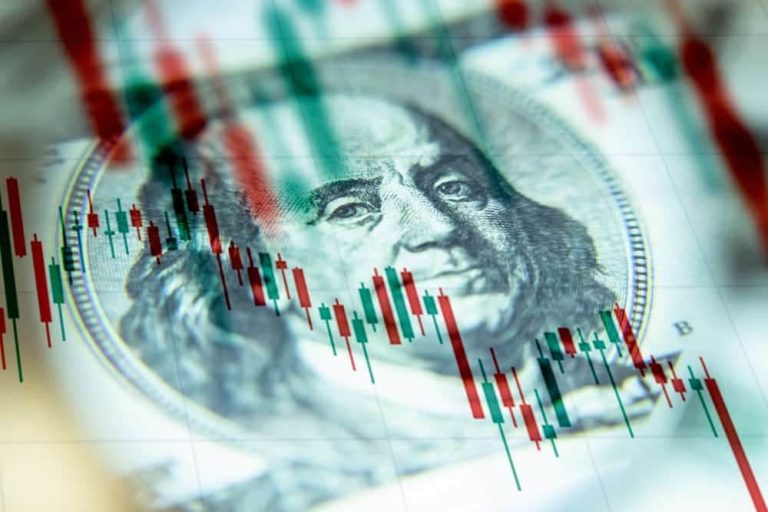
The Dollar Index hit a four-year low. BRICS nations are settling half their trade in local currencies. Central banks are dumping dollars for gold at record pace. And yet the greenback still controls 57 percent of global reserves, 70 percent of foreign debt, and 40 percent of cross-border payments. Is this the beginning of the end — or just another cycle?
By The Index Today Staff · May 20, 2026 · Currency · 11 min read
In January 2026, the U.S. Dollar Index broke below 97.0 for the first time in nearly four years, touching 95.5 — a level that prompted a cascade of headlines about the death of American monetary supremacy. The dollar had just posted one of its weakest annual performances in decades. Goldman Sachs projected a further 3 to 5 percent decline by year-end. Deutsche Bank forecast the index closing 2026 around 99. JPMorgan warned of the “steepest losses” against high-yield currencies like the Australian dollar and Norwegian krone. And across the commentariat, the word that had migrated from academic papers to front pages — de-dollarization — was being deployed with a confidence that suggested the matter was already settled.
It is not settled. It is not close to settled. But something is genuinely shifting, and the honest analysis lies in the space between the alarmists who declare the dollar finished and the complacents who insist nothing has changed. Both are wrong, and the distinction between them matters enormously — for investors, for policymakers, and for anyone who depends on a global economy that is still, for better or worse, denominated overwhelmingly in American currency.
What Has Actually Changed
The dollar’s share of global foreign exchange reserves has fallen to roughly 57 percent — a two-decade low, according to IMF data. That sounds alarming until you consider that 57 percent, in a world with 180 currencies, still represents staggering dominance. The dollar’s reserve share was comparably low in the early 1990s. The current decline is real, but it is not unprecedented.
Where the shift is more pronounced is in what central banks are buying instead. The answer, overwhelmingly, is gold. Global central bank gold purchases have exceeded 850 tonnes annually for four consecutive years — roughly double the long-term average. The LBMA gold price set a record quarterly average of $4,873 per ounce in the first quarter of 2026, with a peak above $5,400. Central banks are not rotating into the euro or the yuan in meaningful size. They are rotating into an asset that has no counterparty, no issuing government, and no vulnerability to sanctions. The message is not “we don’t want dollars.” The message is “we want insurance against a world in which dollars can be weaponized.”
That message traces directly to February 2022, when the United States and its allies froze approximately $300 billion in Russian central bank reserves following the invasion of Ukraine. For central banks in countries that do not fully align with Western foreign policy — China, India, Turkey, Saudi Arabia, Brazil, and dozens of others — the lesson was existential. Dollar reserves, once considered the safest assets in the global financial system, could be seized. The theoretical risk became a demonstrated reality.
The behavioral shift that followed has been the single most consequential development in international monetary affairs since the end of Bretton Woods. It is not a panic. It is not a rush for the exits. It is a slow, deliberate, institutional recalibration by the most conservative financial actors on earth — and it is accelerating.
The BRICS Factor
The BRICS bloc — now expanded well beyond its original membership of Brazil, Russia, India, China, and South Africa — has moved from rhetoric to infrastructure. In January 2026, member nations announced they would increase the share of internal trade settled in local currencies from 35 to 50 percent. Russia and China now settle approximately 90 percent of their bilateral trade in rubles and yuan. BRICS Pay, a multilateral payment platform, has reduced dollar usage in intra-bloc transactions by roughly two-thirds.
The infrastructure is deepening. Russia’s SPFS messaging system, China’s CIPS cross-border payment network, and India’s UPI domestic payment architecture are being connected to create alternative financial plumbing that operates entirely outside dollar-denominated networks. ASEAN has announced plans to establish a regional unified payment system by 2027 specifically to reduce dollar dependence. The share of the Chinese yuan in SWIFT’s trade finance section has quadrupled over the past four years to 8.3 percent.
These are not theoretical developments. They are operational systems processing real money. But it is essential to maintain perspective about their scale. SWIFT still processes the vast majority of cross-border payments, with the dollar accounting for over 40 percent. The yuan’s 2.88 percent share of global payments, while growing, remains a rounding error next to the dollar’s dominance. There is roughly $14 trillion in dollar-denominated credit held outside the United States — loans, bonds, and liabilities that create structural demand for the currency regardless of geopolitical sentiment. The dollar’s share of foreign currency debt issuance has remained constant at around 70 percent since the global financial crisis.
As India’s External Affairs Minister S. Jaishankar put it with characteristic candor: “I don’t think there’s any policy on our part to replace the dollar. The dollar as the reserve currency is the source of global economic stability, and right now what we want in the world is more economic stability, not less.”
The War Premium
The Iran war has introduced a new variable into the dollar equation — one that pulls in contradictory directions. On one hand, the conflict has reinforced the dollar’s traditional role as a safe-haven currency during periods of geopolitical stress. Capital flows into dollar-denominated assets during crises are reflexive and powerful, driven by decades of institutional conditioning.
On the other hand, the war has accelerated precisely the kind of energy trade de-dollarization that J.P. Morgan’s Natasha Kaneva has identified as the most visible frontier of the greenback’s retreat. Russian oil exported eastward and southward is already priced in local currencies. The Hormuz disruption has forced Asian buyers to seek alternative suppliers and alternative payment arrangements. Indonesia is importing Russian crude and citing “independent foreign policy” and BRICS membership as justification. India is signing bilateral energy deals with the UAE that deepen rupee-dirham settlement channels.
The commodity markets, where the dollar’s influence on pricing has historically been most absolute, are the sector where de-dollarization is most advanced and most consequential. And the Iran war, by disrupting the very trade routes that the dollar-denominated system was designed to lubricate, has given countries both the motive and the opportunity to build alternatives.
Cyclical or Structural?
The most important analytical question in currency markets right now is whether the dollar’s 2025-2026 decline is cyclical — driven by Federal Reserve rate cuts, narrowing interest rate differentials, and temporary loss of growth advantage — or structural, reflecting a permanent erosion of the institutional foundations on which dollar dominance rests.
ING’s foreign exchange team offers the most balanced assessment: mostly cyclical, with structural undertones that bear watching. The dollar remains “very strong by historical standards” even after its recent decline. The concentration of risks in the United States — equity valuations, fiscal trajectory, political uncertainty ahead of midterm elections — keeps the balance of risks tilted to the downside, but not catastrophically so.
The structural scenario requires parallel shifts across multiple dimensions simultaneously: reserve diversification, liability restructuring, invoicing changes, payment system migration, and a fundamental reordering of the trust networks that underpin global finance. Those shifts are underway, but they are slow. The dollar’s network effects — the fact that everyone uses it because everyone else uses it — create a self-reinforcing equilibrium that is extraordinarily difficult to break.
J.P. Morgan estimates that each 1-percentage-point decline in foreign Treasury holdings relative to GDP would push yields up by more than 33 basis points — a disciplining mechanism that makes the most dramatic scenarios self-correcting. A world fleeing the dollar would face higher American interest rates, which would attract capital back into dollar assets, which would slow the flight.
What Smart Money Is Doing
The institutional response to the de-dollarization narrative is more nuanced than the headlines suggest. Central banks are diversifying reserves — but slowly, and primarily into gold rather than competing currencies. Sovereign wealth funds are increasing allocations to non-dollar assets — but maintaining dollar positions as core holdings. Corporations are hedging currency exposure more aggressively — but not abandoning dollar-denominated debt issuance.
The smart money, in other words, is treating de-dollarization as a real trend that demands hedging rather than a crisis that demands flight. The distinction matters. A gradual decline in the dollar’s share of global reserves from 57 percent to, say, 50 percent over the next decade would be historically significant but economically manageable. A sudden loss of confidence — triggered by a fiscal crisis, a political breakdown, or a geopolitical miscalculation — would be something else entirely.
The dollar is not dying. But it is being held accountable in ways it has not been since the 1970s. The countries and institutions building alternatives are not doing so because they believe the dollar will collapse. They are doing so because they have learned — from sanctions, from trade wars, from the weaponization of financial infrastructure — that depending entirely on any single country’s currency is a risk they are no longer willing to bear.
The question for the next decade is not whether the dollar remains dominant. It will. The question is whether its dominance remains comfortable — or whether it becomes, for the first time in a generation, something that has to be earned.